Physics of the SQUDE M82 multiphase starburst wind
Overview
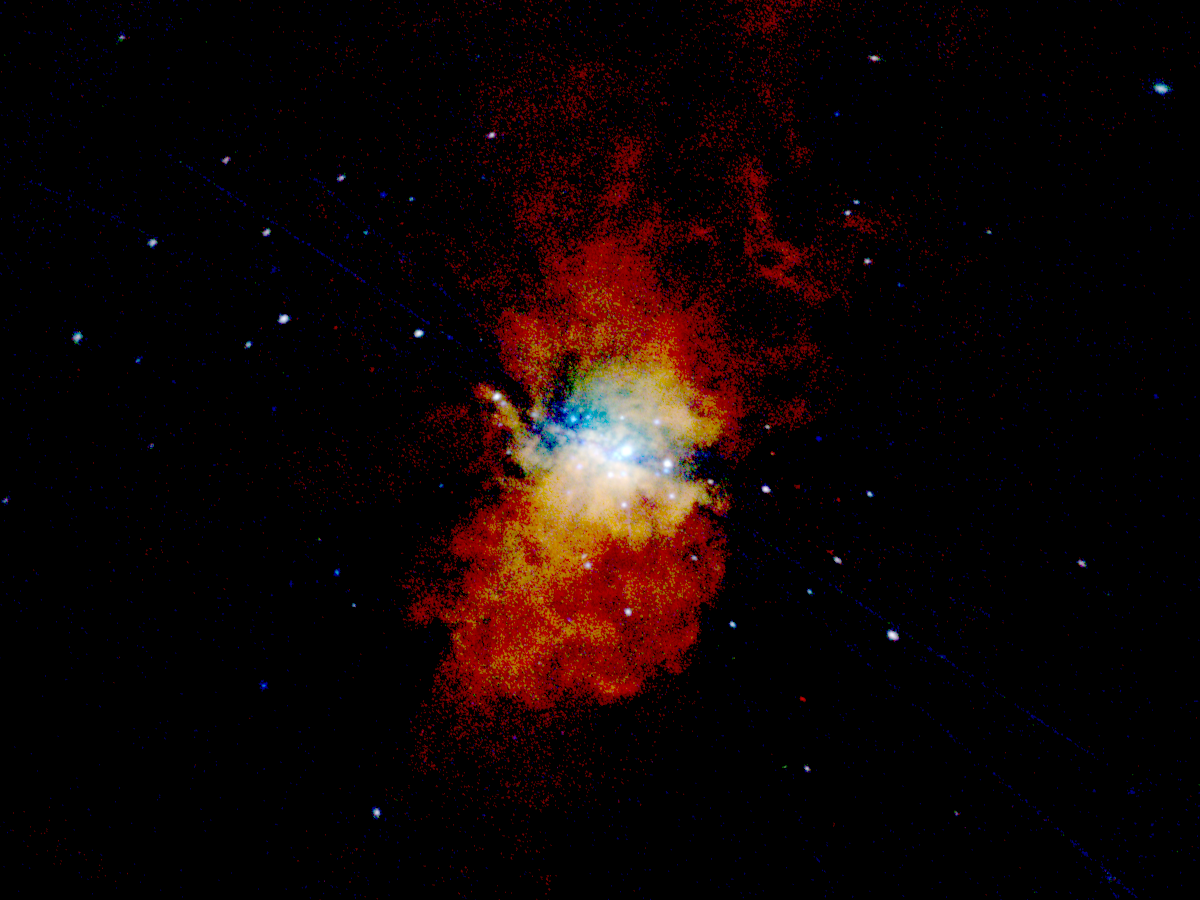
Stellar feedback is driven mainly by supernova explosions and stellar winds, and is the dominant mechanism driving outflows from starburst-galaxy centers. The nearby starburst galaxy M82 (D = 3.5 Mpc) remains a canonical laboratory for studying stellar feedback and galaxy-scale outflows. Decades of multiwavelength observations have established that its galactic wind is intrinsically multiphase, consisting of volume-filling hot plasma, and is widely believed to drive cooler ionized, neutral, and molecular gas components. However, the physical coupling between these phases and the feedback efficiency it determines remain uncertain.
Recently, XRISM made a landmark measurement of the hot-wind fluid in M82, determining its temperature (kT = 2.0 keV) and line-of-sight velocity dispersion (σ ≈ 600 km s⁻¹), and showing that thermal-gas pressure alone can drive a multiphase galactic outflow. However, Resolve’s bandpass (1.8–10 keV) is insensitive to soft X-ray emission below ≲1.8 keV, leaving the physics of how energy and metals are transported through the multiphase wind unconstrained. SQUDE operates over 0.3–4 keV with 4 eV energy resolution, giving it unique leverage on the questions below and making it complementary to XRISM.
Three science goals
1. Thermodynamic bridge: energy coupling in the multiphase outflow
XRISM can fit the spectrum with two thermal components (kT ≈ 2.0 and 0.72 keV) fit the spectrum,but cannot establish the physical connection between phases. In reality, the hot wind and cooler gas form a continuous transition layer through cooling, thermal conduction, and mixing, whereintermediate-temperature regime (kT ∼ 0.2–0.8 keV) corresponding O VII/O VIII and Ne IX/Ne X emission lines are invisible to XRISM. SQUDE can directly measure the thermodynamic state of this phase through line ratios, quantifying radiative losses and the retained kinetic-energy fraction — the feedback efficiency.
Gas at different temperatures also shows significant velocity differences(such as O VIII and Mg XII),indicating decoupling in momentum transfer between phases. SQUDE can measure the velocity dispersion of multiple lines simultaneously and reconstruct how momentum-transfer efficiency varies with temperature, constraining the acceleration mechanism of the multiphase wind.
2. Metal transport: direct evidence for CGM chemical enrichment
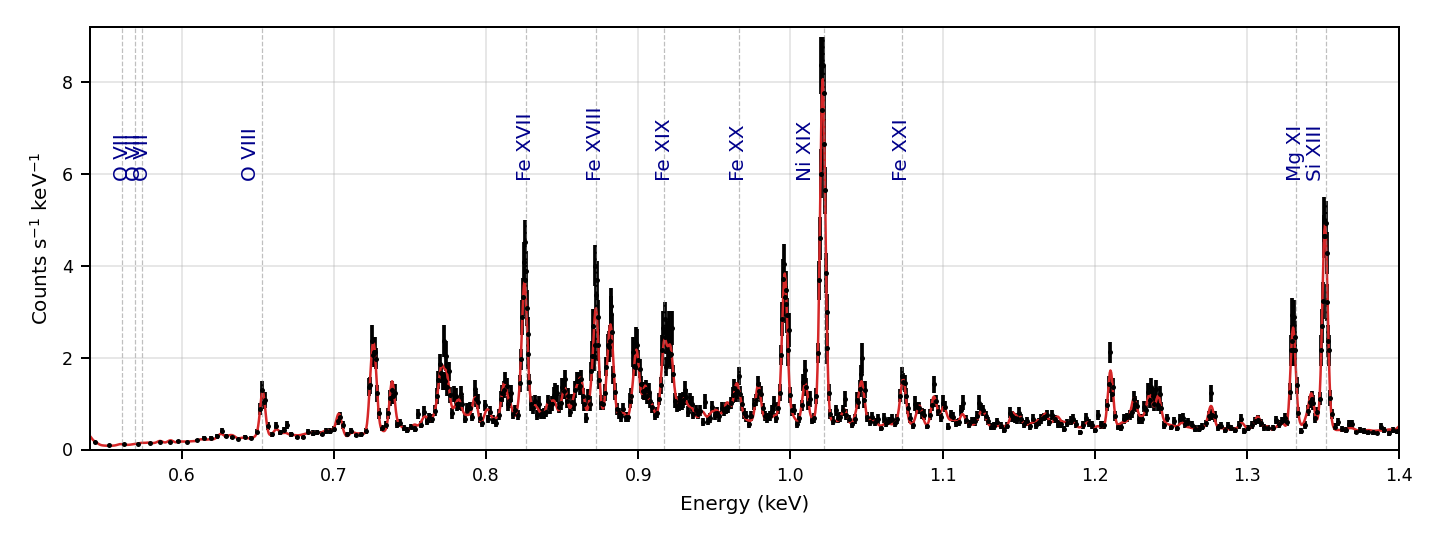
XRISM is limited by the degeneracy between gas density and metallicity and must assume solar abundance, causing an uncertainty of ∼2 in the metal outflow rate. SQUDE can resolve O, Ne, and Mg emission lines, breaking this degeneracy and improving abundance precision, while directly measuring the radially resolved metal outflow rate ṁ_metals(r).
This directly answers how much supernova-produced metal escapes into the CGM/IGM and how much returns to the galactic disk — a key observable for constraining closure of the baryon cycle, for which M82 is an ideal laboratory.
3. Non-equilibrium ionization and outflow timescale
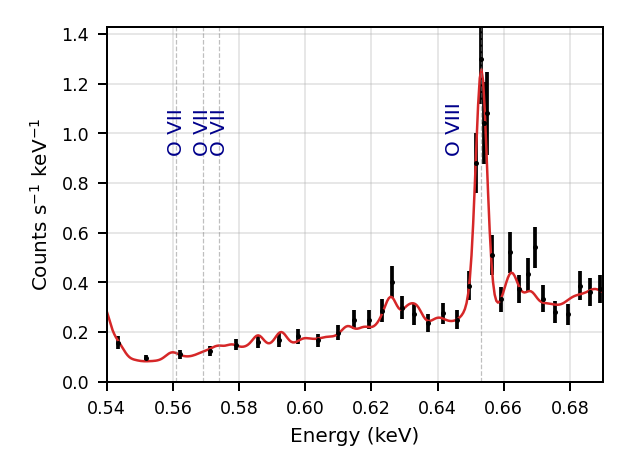
A rapidly expanding starburst wind may drive the plasma away from CIE. The O VII triplet at 0.57 keV (especially the forbidden-to-resonance line ratio) is the most sensitive ionization-state diagnostic, but is outside XRISM’s coverage. If SQUDE detects its NEI signature, it will indicate that the outflow timescale is shorter than the ionization-equilibrium time, directly constraining the outflow age and recent energy-injection history.
50 ks simulated-spectrum case
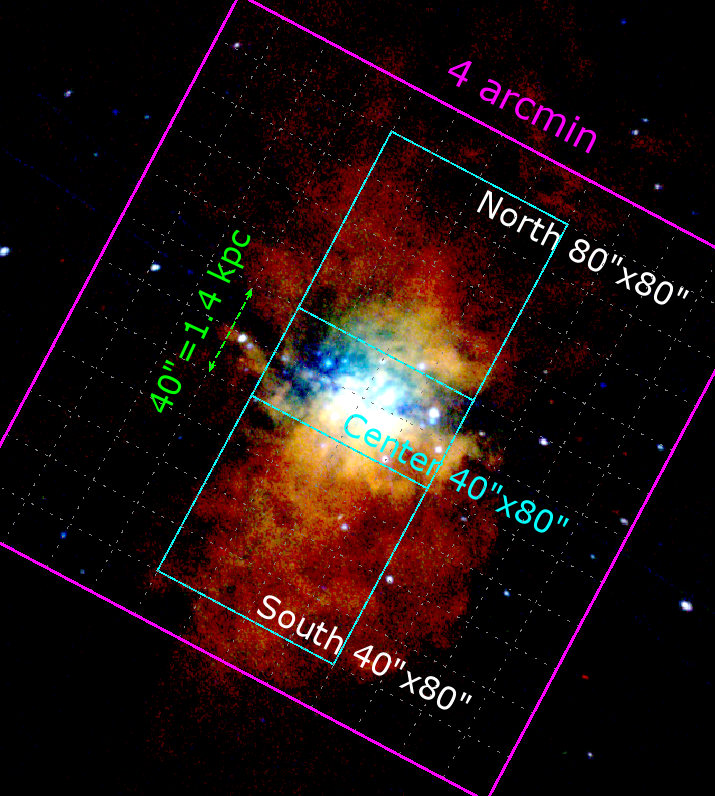
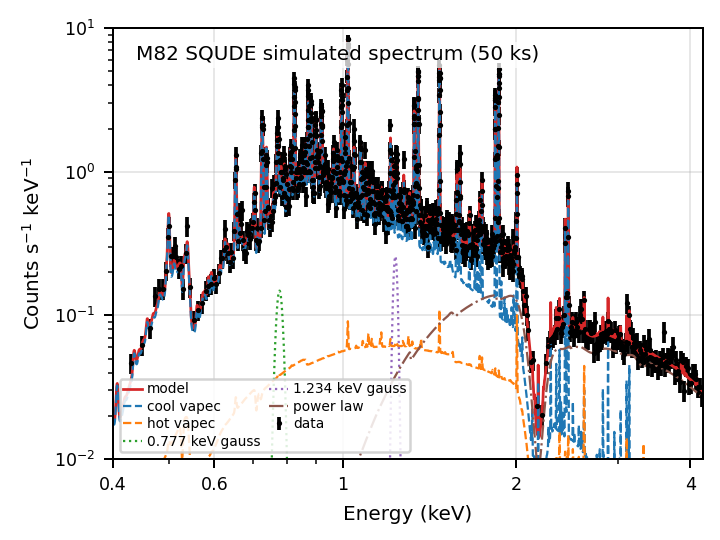
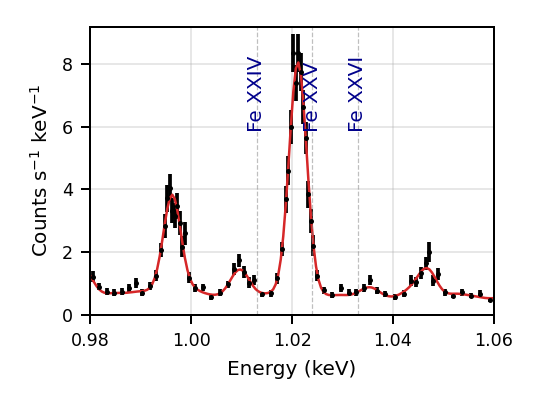
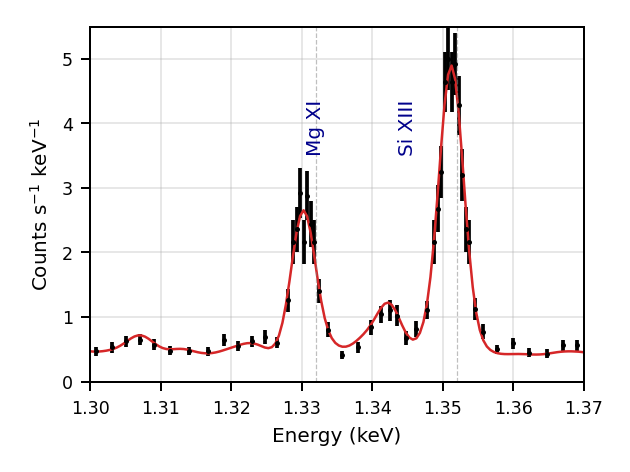
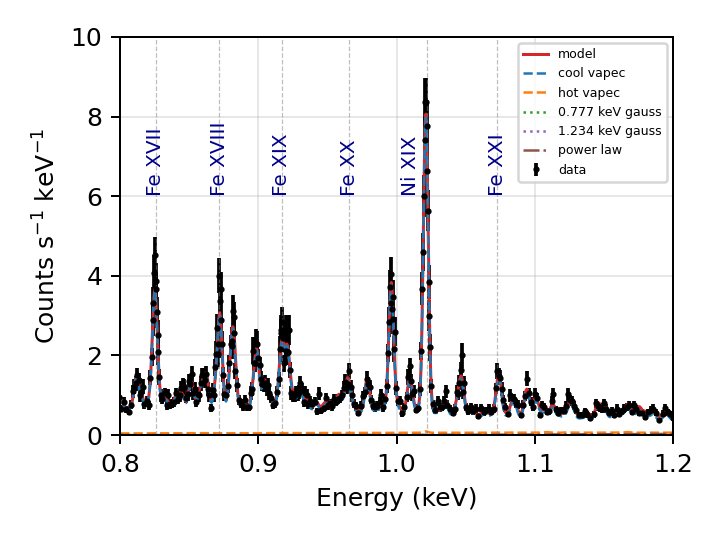
Using a spectrum anchored to Chandra archive data together with the SQUDE response matrix, we simulated a 50 ks observation of the central 4×4 arcmin region of M82. SQUDE will simultaneously measure the cool phase (kT∼0.7 keV) andhot phase (kT∼2.0 keV) thermodynamic properties, chemical composition, and kinematics of both phases in the outflow with high precision.
Key measurement precision
Emission-line zooms
Single-element abundance-scan simulations
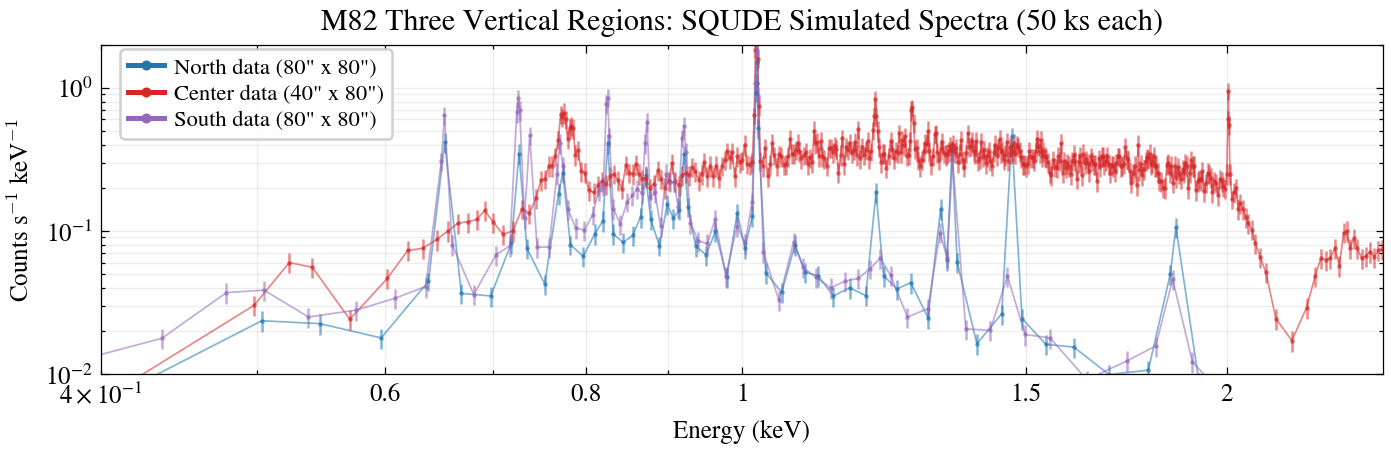
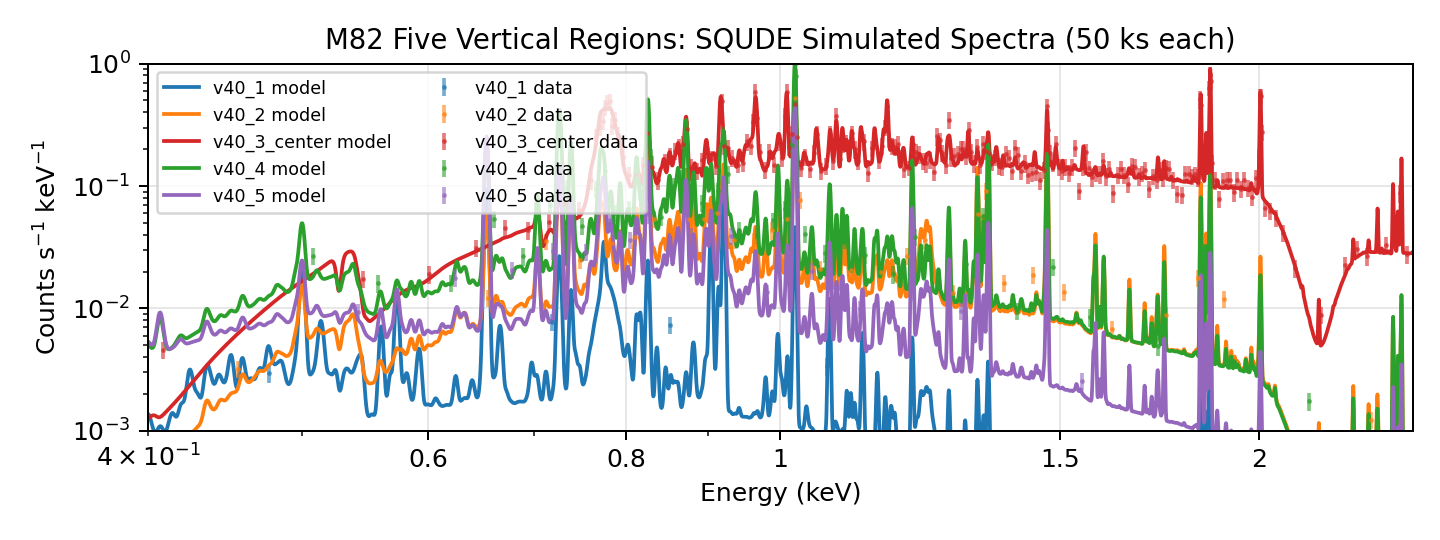
Spatially resolved (sub-grid) spectral analysis
The 50 ks exposure is sufficient for the core science goal: quantitatively measuring energy and metal transport in the M82 outflow, resolved by thermal phase. The very high surface brightness of the M82 outflow further makes spatially resolved (“sub-grid”) spectroscopy possible in a single pointing, allowing the plasma properties to be mapped as a function of distance from the starburst region.
Even if the 4×4 arcmin field is divided into multiple spatial regions(for example, an inner region ≲0.7 kpc and an intermediate region ∼1–4 kpc), the 50 ks exposure is expected to provide enough photon statistics for high-resolution spectral fitting in each region.
Systematic-error assessment
We systematically assessed the main observational systematics through a series of 50 ks simulations.In bracket simulations adding sky/instrumental background and foreground O VII, bracket in the simulations(with background normalization varied ±20%、unresolved point-source residuals 0.5–1.5× Chandra),the statistical errors on soft-band abundances increase by only about 1.2–1.3×(O)or <1.06×(Ne、Mg、Fe),temperatures are nearly unaffected, showing that the core 50 ks measurements remain robust under reasonable background uncertainties.
Main remaining sources of systematic error:
- Foreground O VII — affects O abundance and the O VII triplet diagnostic
- Central unresolved point-source residuals — affects abundances in spatially resolved wind regions
- PSF leakage — affects abundances in spatially resolved wind regions
These will be controlled through joint modeling with the Chandra point-source catalog and SQUDE blank-field/background templates.
Research context and positioning
This study traces the full evolution of feedback in a unified framework: from energy injection (AGN/stellar feedback) to dynamical propagation, and then to its impact on the galaxy and CGM environment. Observations of M82 with SQUDE will move the study of feedback from "static depiction"to"time-traceable、physically quantitative".
M82 has a unique advantage in this experiment: its proximity and brightness make it the only system currently able, at this fine scale, to observationally constrain feedback physics resolved by thermal phase and dependent on position, turning diagnosis of global outflow properties into a spatially resolved, physically interpretable picture of outflow evolution.
SQUDE vs XRISM complementarity
| Instrument | Band | Resolution | Key M82 diagnostics |
|---|---|---|---|
| XRISM/Resolve | 1.8–10 keV | ∼5 eV @ 6 keV | Fe XXV/XXVI, hot wind (kT∼2 keV) |
| SQUDE | 0.3–4 keV | ∼4 eV | O VII/VIII, Ne IX/X, Mg XI, Fe-L, intermediate-temperature regime (0.2–0.8 keV) |
| XMM-Newton/RGS | 0.4–2.0 keV | ∼300 (E/ΔE) | historical observations; limited by LSF broadening |
SQUDE fills the temperature gap between the XRISM hot-wind fluid and the soft diffuse Chandra/XMM wind (0.2–0.8 keV), and is indispensable for understanding energy coupling and metal transport in multiphase outflows.